
The Question Nobody Asks
Every shop has a punt.
Back to Journal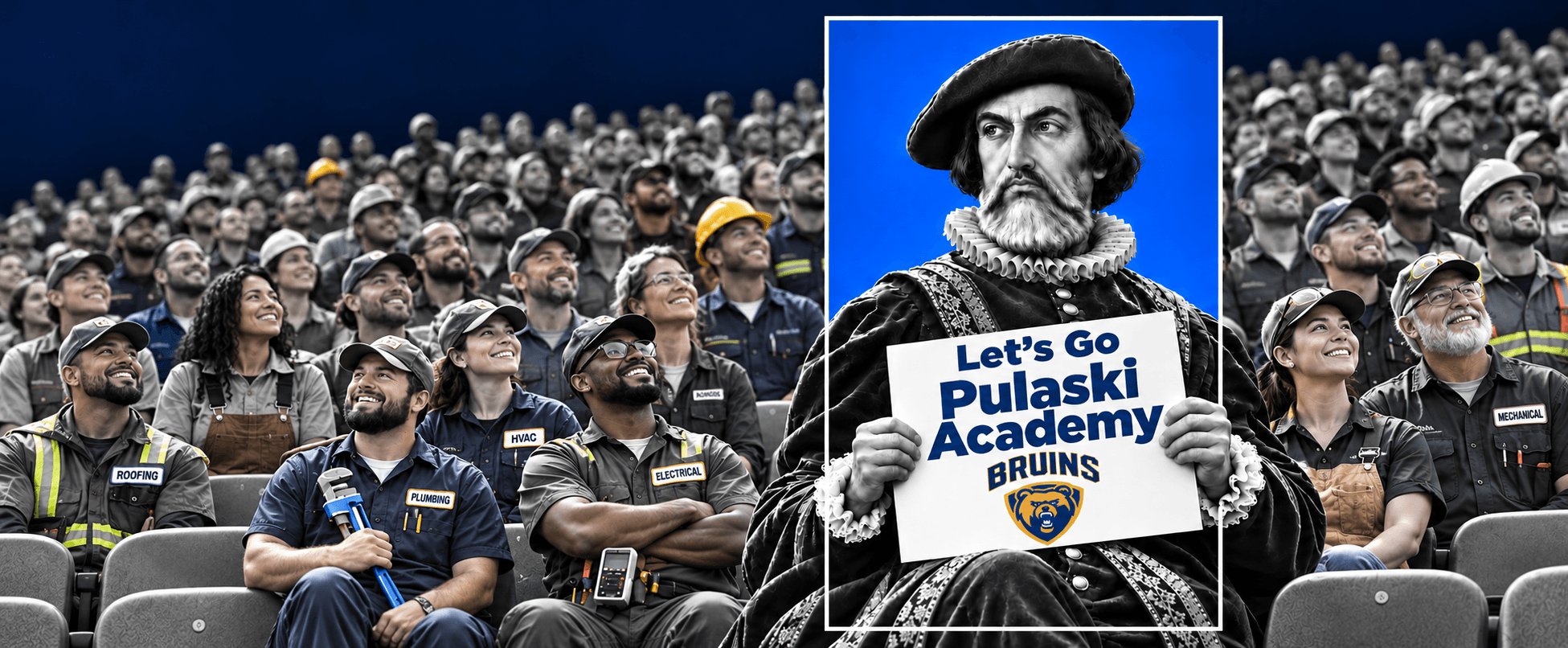
In 1519, a Spanish company of about 500 soldiers landed in Mexico and set out to conquer the Aztec Empire.
Their leader, Hernán Cortés, knew some of his men wanted to go home.
As his army went ashore, he gave one order that changed history.
Burn the boats.
Why would a leader destroy his own way home?
Because when you need an entire army to commit to a single mission, turning back can’t be an option.
Two years later, in 1521, Cortés’s army did conquer the Aztec Empire.
That’s why “burn the boats” still means going all in today.
486 years later, a coach from Pulaski Academy, in Little Rock, Arkansas, burned the boats again and made an entire sport rethink how to play the game.
To see what he changed, watch a game on any given Sunday.
On fourth down, the punter jogs onto the field. The offense heads to the sideline. And nobody asks why. It’s just what football teams do.
The play nobody questions
Kevin Kelley asked why.
In 2003, he took over as head coach at Pulaski Academy. His question was one most coaches never ask: What if we don’t punt?
The math behind the punt
So Coach Kelley went looking for an answer. He found a video about research on punting. Its message was simple: Coaches punt too often.
The numbers backed it up. An economist named David Romer studied three NFL seasons. He found 1,068 fourth downs where going for it was the smarter call. Teams took that chance only 109 times.
Romer studied the pros, though. Coach Kelley coached high school. He needed the math for his own team.
A punt moved the ball only about 30 yards. Going for it worked about half the time.
But what if it didn’t work?
Say your team is backed up near its own goal line. If you punt, the other team still scores a touchdown 77 times out of 100. If you go for it and miss, that jumps to 92.
Punting only lowered the risk by about 15 points. Going for it gave his team a 50-50 shot to keep the ball.
The punt wasn’t the safe play. It only felt that way.
Most coaches look at the field and ignore the numbers, so they keep kicking.
Burning the boats
Coach Kelley stopped kicking. Just not overnight. In his first season, his team still punted 21 times in 15 games.
By 2007, the punting was over. Before long, there wasn’t even a punter on the roster.
Now there was no way back.
That’s the definition of burning the boats, and if Cortés were in the stands, he’d be cheering them on.
And that choice changed more than fourth down. Most teams get three tries to move the ball 10 yards, then punt. His team got four. That’s one extra chance on every drive.
Coach Kelley wasn’t betting on perfect. He was choosing which risk was worth taking.
Fourth down, nowhere to go
It’s the 2008 state title game. Pulaski Academy has the ball on its final drive.
Fourth down. No punter. Miss, and the other team gets the ball.
They go for it, and they make it.
Fourth down again. Same call. Same result.
Then a third time. Then a fourth.
Four for four.
Pulaski Academy leaves with the state title.
It looked like a gamble. To Coach Kelley, it was math.
It wasn’t one lucky night
Coach Kelley’s teams won 216 games, lost 29, and tied one. After they stopped punting, they won eight state titles in 13 seasons.
Bill Belichick, winner of six Super Bowls, called him the top high school coach in the country.
To be fair, punting wasn’t the only thing Coach Kelley changed. He also rethought onside kicks, two-point tries, and his offense. Nobody can prove that skipping the punt alone made the difference.
Here’s what the record does show: He stopped punting, and his team kept winning titles.
Your shop’s fourth down
Every shop has a punt.
Maybe it’s a type of call you turn down because those jobs “never pay.” Maybe it’s a service you dropped years ago. Who checked? Was the problem the work, the price, or the way it was scheduled?
Most owners miss what happens next. When you say no to a customer, they call someone else. Next time, they call that shop first.
Saying no looks smart in the short term. You skip a job that doesn’t pay.
Saying yes plays the long game. When that customer has their next problem, they call you, and the second job pays for both.
That’s called customer lifetime value: what a customer is worth over every job, not just this one. Most shops ignore it.
Turning that call away is the punt. It feels safe, but it hands the ball to the other team.
Your Moneyball move: Pick one punt. Run the numbers. If they say go for it, commit. Tell your team, “We are taking these calls. They are a long-term investment.”
Burn the boats.
That’s Moneyball for the Trades.
In Chapter 2 of Moneyball for the Trades®, you’ll learn how one owner questioned a cost everyone else accepted.
Not sure where your shop is punting? Start with your Moneyball IQ.
Sources: Sports Illustrated, September 17, 2009 (punt yardage, conversion rate, 77 and 92 percent, Romer’s 1,068 and 109 (David Romer, University of California, Berkeley), no punts since 2007, no punter on the roster, 2008 title drive): Read source. Sports Illustrated High School, December 13, 2020 (ninth title, Belichick quote): Read source. Wikipedia, “Kevin Kelley (American football)” (216–29–1 record and title years): Read source. Wikipedia, “Bill Belichick” (six Super Bowl wins as a head coach): Read source. USA Football, Kelley explains his approach, 2018 (21 punts in his first season). Sports Illustrated, “The Kevin Kelley Way,” May 21, 2021. Cortés: Mental Floss and the University of Miami.